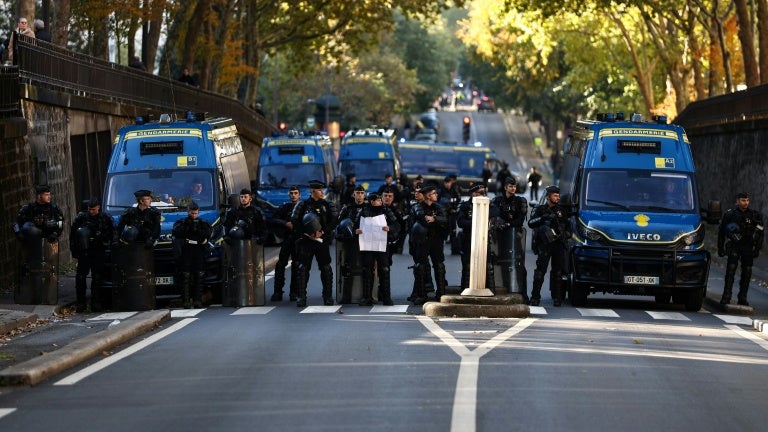
French prosecutors have opened an attempted homicide investigation after a Molotov cocktail was thrown at gendarmes in Paris during the October 31 mobilisation, BFM reports. The device exploded at the feet of a member of the security forces at Porte de Charenton in the 12th arrondissement, leaving him lightly injured, according to the outlet. Interior Minister Laurent Nuñez had described the attack as an attempted murder the previous day.
Why it matters
The inquiry marks an escalation in how authorities are treating violence that has accompanied weeks of social unrest in France. It also comes as the government faces pressure on several fronts at once: street protests, a contested budget and a youth movement that shows no sign of standing down. According to BFM, a government source acknowledged a "failure of anticipation in intelligence" on October 17, when police were repeatedly overwhelmed, while praising how Saturday's demonstration was handled.
What happened at Porte de Charenton
Photos and video from AFP, cited by BFM, captured the homemade device detonating beside the officer. A gendarme who was targeted gave a graphic account of the moment to Orange Actualités, saying the burning substance began to sting his skin. The Paris prosecutor's office confirmed to BFM that the case is now being pursued as an attempted homicide.
Nationwide, the Interior Ministry counted 779 arrests during the October 31 demonstrations and the Halloween night that followed, BFM reports. In the capital alone, the prosecutor's office told the outlet, there were 105 arrests — 88 linked to the protests and 17 during Halloween festivities. Of those, 89 people were in police custody in Paris: 61 adults and 22 minors, with the ages of six individuals still being established. The figures may therefore change.
BFM reports that Saturday's marches unfolded in a calmer atmosphere than those of October 17 and 24, though the executive branch says it remains watchful. "We must show humility and vigilance for the coming days," a government source told the outlet. The same source said the mobilisations "must find a political response in the short term from the government, and in the medium term through the presidential election," adding that "in a republic, when the time of the ballot box arrives, the street takes a back seat."
Unions and students prepare a new round
Attention is already turning to Thursday, when unions have called another day of action. Cyrille Lama, confederal secretary of Force Ouvrière, told BFMTV the day would be "massive," describing a broad inter-union effort joined by organisations that did not sign the original call, and aimed at employees, workers, retirees and young people.
Julien Troccaz of SUD-Rail urged a step up in the strike and called for the economy to be blocked on Thursday, telling BFMTV that anger must be expressed by stopping work and taking to the streets.
The school front is moving faster. Pierre Sourzat, who leads the Lycéens organisation, called on RMC for lycées to be blockaded from Monday, criticising what he called the government's "counter politics" after it unveiled measures earlier in the week intended to calm young people's anger. Sophie Vénétitay, general secretary of SNES-FSU, told BFMTV the ball is now in the government's court and that it must answer young people's demands for the school year to return to normal, noting that youth organisations feel their grievances have not been fully met.
BFM reports that Lycée Vauquelin in Paris is approaching the start of term with a mix of eagerness to see students again and concern about renewed unrest; its door was set on fire during a blockade on October 5. Mathilde Panot, who chairs the LFI group in the National Assembly, told La Tribune Dimanche that the government's response falls short, saying students had sought 10 billion euros for lycées and higher education and received 400 million.
Budget and political fallout
The unrest is unfolding alongside a budget fight. Philippe Juvin, general rapporteur for the finance bill, told France Info that Parliament will reject the budget, two days before the National Assembly votes on the first part of the text covering revenues. The LR deputy said he has argued since August that a 49.3 procedure — the constitutional tool allowing a bill to pass without a vote — will be necessary.
Within the centre-right, the question of a joint presidential candidate remains unresolved. Marc Fesneau, who heads the Les Démocrates group, told La Tribune Dimanche he favours a primary stretching "from social democrats to the republican right," saying that despite the difficulties he sees no other way to produce a candidate. Jean-François Copé, the LR mayor of Meaux, told BFM Politique that a primary proposed by Gabriel Attal will not happen because its participants cannot agree on who would take part. Copé also accused Jean-Luc Mélenchon of a deliberate, theorised strategy of radicalisation, saying LFI blurs its image between protest and violence.
What to watch: Thursday's inter-union mobilisation and whether lycée blockades materialise from Monday, alongside the National Assembly's budget vote and the course of the attempted homicide inquiry in Paris.